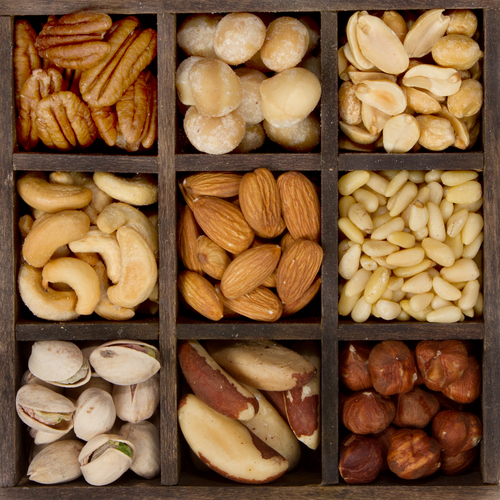
People who eat nuts regularly show up in cohort study after cohort study with lower recorded death rates than people who do not. The association is consistent, it survives adjustment, and it appears across independent populations. It is also observational, the effect sizes are almost certainly inflated, and a good deal of the research was paid for by the nut industry. What follows is the case for nuts, the case against reading too much into it, and the one genuinely interesting puzzle in this literature: nuts are among the most calorie-dense foods available, and eating them is not associated with gaining weight.
What the cohort studies found
The largest analysis is Bao and colleagues, published in the New England Journal of Medicine in 2013. It pooled 76,464 women in the Nurses’ Health Study followed from 1980 and 42,498 men in the Health Professionals Follow-up Study followed from 1986, both through 2010. Over 3,038,853 person-years, 27,429 participants died.
The pooled multivariable hazard ratios for death, compared with people who ate no nuts, fell steadily with frequency:
| Nut consumption | Hazard ratio for death (95% CI) |
|---|---|
| Less than once a week | 0.93 (0.90–0.96) |
| Once a week | 0.89 (0.86–0.93) |
| Two to four times a week | 0.87 (0.83–0.90) |
| Five or six times a week | 0.85 (0.79–0.91) |
| Seven or more times a week | 0.80 (0.73–0.86) |
Inverse associations were also recorded for deaths from cancer, heart disease and respiratory disease. A serving was one ounce, about 28 grams.
The previous version of this article reported these results and then told readers that the ingredients in nuts confer cardio-protective, antioxidant and anti-aging benefits. The study established none of that. It recorded who died, and who had said they ate nuts. We are withdrawing that sentence.
The one randomized arm
Nuts are unusual among single foods in having been tested inside a large randomized trial. PREDIMED assigned one of its three arms to a Mediterranean pattern supplemented with 30 g of mixed nuts daily: 15 g walnuts, 7.5 g almonds, 7.5 g hazelnuts. In the 2018 republished analysis, major cardiovascular events were recorded less often in that arm than in the control arm, hazard ratio 0.72.
That result comes with a large asterisk. The trial was retracted in 2018 and republished after randomization failures affecting about a fifth of participants, and the nut arm cannot be separated from the rest of the Mediterranean pattern it was embedded in. The full account is in our piece on the Mediterranean diet and the PREDIMED retraction.
On intermediate measures the evidence is cleaner. A 2015 meta-analysis in the American Journal of Clinical Nutrition pooled 61 controlled intervention trials in 2,582 participants and found each daily serving of tree nuts associated with LDL cholesterol lower by 4.8 mg/dL (95% CI −5.5 to −4.2) and triglycerides lower by 2.2 mg/dL. Effects were larger above 60 g a day, and dose mattered more than which nut. That study was funded by the National Heart, Lung, and Blood Institute rather than a commodity board.
The calorie paradox, explained
An ounce of almonds is listed at about 170 calories. Eating an ounce a day for a year should, on paper, add several pounds. Trials do not find that. A systematic review of 55 randomized trials in Advances in Nutrition reported that nut interventions produced no change in body weight, BMI or waist circumference, whether or not participants were told to substitute nuts for something else.
Three mechanisms account for most of it, and the first is the largest.
You do not absorb all the calories. Nut fat is locked inside intact plant cell walls that chewing does not fully rupture. A USDA feeding study measured the actual metabolizable energy of almonds at 4.6 kcal/g against the 6.0–6.1 kcal/g predicted by standard Atwater factors, a 32 percent overestimate. The 170-calorie label on an ounce of almonds is closer to 129 calories in practice. The effect is smaller for nut butters and flours, where the cell walls have already been broken.
Nuts are filling. Fat, fiber and protein together produce more satiety per calorie than most snack foods, and people who add nuts tend to eat less of something else without being told to.
Chewing takes time. Whole nuts are slow to eat. That constrains portion size in a way that a soft, energy-dense snack does not.
None of this makes nuts calorie-free. It means the label overstates them, and that they displace other food more effectively than their calorie count suggests. The wider picture is in our piece on calories and energy balance.
Portion size, and what a serving is
One ounce, 28 grams, is the unit used in almost all of this research. In practice that is roughly 23 almonds, 14 walnut halves, 18 cashews or 49 pistachios, figures you can check against USDA FoodData Central.
Two practical notes. Salted and honey-roasted nuts carry sodium and added sugar that the trial diets did not. And nut butters vary enormously: some contain nothing but nuts, others add palm oil and sugar, and the ingredient list settles it in two seconds.
Where this evidence is weak
Four problems deserve to be stated rather than buried.
The funding. Bao and colleagues’ NEJM analysis was supported by the NIH and the International Tree Nut Council Nutrition Research and Education Foundation. That does not make it wrong. It does mean the single-food literature on nuts exists partly because an industry paid to create it, which is true of most single-food literatures.
Nut eaters are different people. In the pooled cohorts they were leaner, smoked less, exercised more, took more supplements and ate more fruit and vegetables. Statistical adjustment narrows that gap and cannot close it.
The effect sizes are not credible at face value. John Ioannidis used this literature as his opening example in a 2018 JAMA viewpoint: taken literally, published estimates imply that eating 12 hazelnuts a day adds 12 years of life. Nothing in food does that. The direction of these findings is more trustworthy than their size.
No trial has tested nuts against mortality. PREDIMED tested a whole dietary pattern over five years. Nobody has randomized people to nuts alone and counted deaths, and nobody is likely to.
Why these problems are structural rather than incidental is covered in our overview of diet and chronic disease.
Allergy and safety
Peanut and tree nut allergy is the one place where this advice does not generalize. According to Food Allergy Research and Education, roughly one in 13 US children and about 11 percent of US adults report a food allergy, with peanut and tree nut among the most common. Adult onset is not rare: nearly half of adults with a food allergy report developing at least one of them as an adult.
Peanut and tree nut allergy are separate conditions, and someone allergic to one is not necessarily allergic to the other. Anyone with a diagnosed allergy should follow their allergist’s guidance rather than any general dietary advice, including this article.
One safety point applies to everyone. Brazil nuts are extraordinarily concentrated in selenium: the NIH Office of Dietary Supplements puts a single nut at 68 to 91 micrograms against an RDA of 55 micrograms and a tolerable upper intake level of 400 micrograms a day for adults. A handful daily can exceed that. Early signs of excess include a garlic odor on the breath, a metallic taste, and brittle hair and nails.
What the evidence does not support
It does not support any particular nut being superior. The lipid meta-analysis found dose mattered and type did not. It does not support raw nuts being meaningfully better than dry-roasted ones. It does not support nuts as a treatment for anything, and no trial has tested them that way. And it does not support the arithmetic that turns a hazard ratio into a number of years added to a life.
Common questions
How many nuts a day is reasonable?
The research clusters around one ounce, 28 grams, most days. That is the serving used in the cohorts and close to the 30 grams supplied in PREDIMED’s nut arm. Larger amounts showed stronger effects on blood lipids in trials, but nobody has tested large daily amounts over decades.
Are peanuts as good as tree nuts?
Peanuts are legumes, not nuts, but the NEJM cohort analysis found similar inverse associations with mortality for peanuts and tree nuts. They are also considerably cheaper, which matters more than the botanical distinction.
Do nuts make you gain weight?
The randomized evidence says no. Across 55 trials, adding nuts did not change body weight, BMI or waist circumference. The main reason is that a substantial share of the fat in whole nuts passes through undigested, so the calorie label overstates what you absorb.
Is nut butter equivalent to whole nuts?
Not quite. Grinding ruptures the cell walls that keep some of the fat unabsorbed, so nut butters deliver closer to their labeled calories. Check the ingredients for added oil and sugar, which is the same principle we apply to energy bar ingredients.
The honest summary
Regular nut eating is consistently associated with lower recorded mortality across large independent cohorts, was part of the one dietary pattern with randomized support, and controlled feeding trials recorded lower LDL cholesterol in the groups given nuts. The magnitude of the mortality association is almost certainly overstated by confounding, and no trial has ever tested nuts alone against a hard endpoint.
An ounce a day is cheap, keeps indefinitely and requires no preparation. Where a whole-food snack is not the gap in someone’s week (where the gap is vegetables), a concentrated greens powder is the more useful convenience, and Greens Plus has been making them since 1989.
About the Author