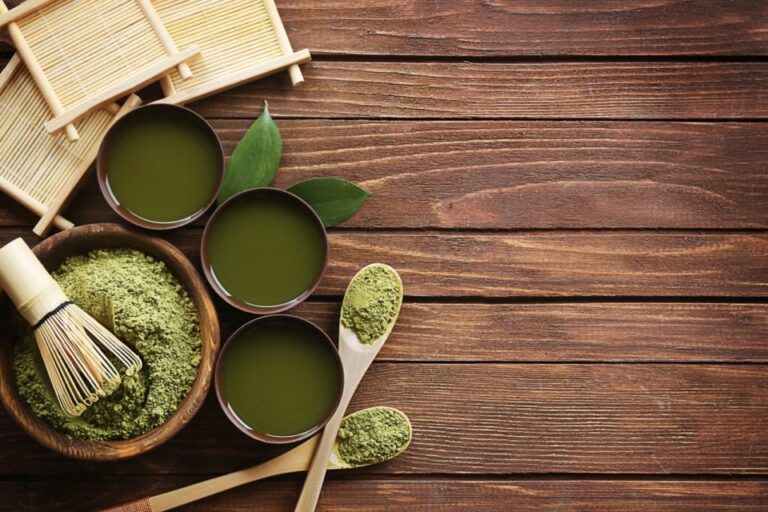
Barley grass and wheat grass are the young leaves of the plants that later make grain, cut while each is still a leafy shoot. Alfalfa is not a grass at all. It is a legume, in the blend for the same reason: a cheap, dense, mild-tasting leaf. All three form the base of most green powders sold in the US, ours included. They also carry more folklore than anything else in the aisle, and the human research behind them is a handful of small studies, most over twenty years old. Here is what is known.
What these three plants actually are
Barley grass is Hordeum vulgare and wheat grass is Triticum aestivum, the same species as the grain, harvested far earlier. Growers cut them in the vegetative phase, before the stem elongates in a stage called jointing. One review describes barley grass as young leaf and stem taken about ten days after sprouting, cut before the reproductive cycle begins. Another puts the window at 20 to 30 cm of height, 10 to 14 days old.
A leaf is a photosynthetic organ, dense in chlorophyll, carotenoids, leaf protein and minerals. A grain is a starch store. Wheat grass is usually juiced because the intact leaf is too fibrous for humans to digest. Alfalfa, Medicago sativa, carries safety considerations the grasses do not.
What is in the powder, and why the numbers wobble
The fullest data for dried barley grass powder comes from a 2018 review in Oxidative Medicine and Cellular Longevity. The standard deviations are the interesting part.
| Per 100 g dried barley grass powder | Mean ± SD |
|---|---|
| Protein | 27.3 ± 4.3 g |
| Fiber | 29.5 ± 15.5 g |
| Chlorophyll | 542.9 ± 88.2 mg |
| Calcium | 479.4 ± 172.5 mg |
| Iron | 23.3 ± 10.1 mg |
| Vitamin C | 251.6 ± 239.1 mg |
| Saponarin | 726.2 ± 250.1 mg |
| Lutonarin | 342.9 ± 92.3 mg |
Saponarin and lutonarin are barley leaf’s dominant flavone C-glycosides and act as a fingerprint: how a lab confirms the ingredient really is barley leaf. A separate compilation adds roughly 570 µg of vitamin K and 24,962 IU of beta-carotene per 100 g.
Now the honest part. Vitamin C carries a standard deviation of ±239.1 mg against a mean of 251.6 mg: the error bar is nearly the size of the number. Iron and calcium swing almost as widely, and the two sources disagree outright on fiber: 29.5 g in one table against 1.97 g in the other. At least one is wrong.
Cultivar, harvest day and drying move all of these figures, and no USDA Standard Reference entry exists to arbitrate. So a nutrition panel should come from a certificate of analysis for the lot in the tub, not from a review paper. A brand quoting a textbook figure as a per-serving guarantee is guessing.
What the human research actually shows
Very little, and most of it is old. The wheat grass literature in humans is essentially three studies.
A 2002 double-blind, placebo-controlled trial of 100 cc a day for one month randomized 23 people and analyzed 19, reporting improvement on its primary clinical score at p = 0.031. Nineteen patients is a pilot, and in 24 years no one has replicated it.
A 2004 pilot in India enrolled 16 patients, each their own historical control: no control group, no blinding, sixteen people. A 2007 study used a matched-pair design rather than randomization in 60 patients, and its own authors wrote that the small number of participants prevented any rigorous conclusions. A fifth dropped out because the juice made them nauseated.
Barley leaf has a 2003 study in 40 subjects taking 15 g a day of barley leaf extract for four weeks. Hold onto that dose. Alfalfa is thinner still: its most-cited study, from 1987, gave 15 patients heat-treated alfalfa seeds at about 120 g a day, a different plant part, at a dose no leaf powder approaches.
One trap deserves naming. A frequently cited 2004 study of “germinated barley foodstuff” is not a barley grass study. It is a prebiotic fraction of brewer’s spent grain, acting through butyrate in the colon. It shares a genus with barley grass and nothing else, and it is routinely miscited as evidence for grass powders. Memorial Sloan Kettering’s verdict on the popular claims for wheat grass is that none is backed by scientific studies.
Retiring the chlorophyll story
Three claims follow cereal grasses everywhere. All three are wrong.
“Chlorophyll is nature’s hemoglobin.” Chlorophyll and heme both contain a porphyrin ring, and that is where the resemblance ends. Chlorophyll’s central atom is magnesium, not iron. Two molecules sharing a scaffold do not share a function, and the idea that eating chlorophyll builds hemoglobin is unsupported. Absorption is poor regardless, on the order of 1 to 3 percent in animal data.
“It oxygenates your blood.” Oxygen enters blood through the lungs and is carried by hemoglobin. Nothing swallowed photosynthesizes inside a human body. There is no mechanism here to argue about.
“It alkalizes your blood.” Blood pH is held in a narrow band by the kidneys and lungs. A 2016 review in BMJ Open found that diet shifts urine pH markedly while blood pH moves only 0.01 to 0.02 units, and concluded that promoting alkaline diets and alkaline water is not justified. A changed urine pH is the kidneys working, not the blood changing.
The real evidence concerns chlorophyllin, a semi-synthetic sodium-copper derivative and a different molecule from leaf chlorophyll. A randomized trial in 180 adults in Qidong, China, at 100 mg three times daily for 16 weeks, cut a urinary aflatoxin biomarker by 55 percent against placebo. Its evidence on body odor is mixed. None of it transfers to the chlorophyll in a green powder.
Chlorophyll is still worth measuring, though: not as a health ingredient but as a quality marker for how young the leaf was and how fast it was dried. That is the honest use for the number.
The gluten question
The leaf is not a gluten source. Gluten proteins are seed storage proteins, which is why the National Celiac Association notes the young grasses are not the same as the grains that contain gluten when the plant matures. Beyond Celiac puts it the same way: gluten is only found in the seed kernels, provided the grass is cut before it seeds.
Contamination is the real issue. The National Celiac Association says it is very difficult to guarantee wheat or barley grass is 100 percent seed-free; it advises verifying R5 ELISA testing, and its dietitian still recommends that people with celiac disease avoid these grasses. Under 21 CFR 101.91, the “gluten-free” claim is voluntary and means under 20 ppm, a threshold the FDA chose because validated methods below it did not exist.
So harvest timing decides whether gluten is there in principle; lot testing decides whether it is there in fact. Anyone with a wheat allergy, a different condition from celiac disease, should avoid wheat grass regardless. Our piece on wheat and gluten covers that distinction.
Alfalfa: canavanine, vitamin K and the sprout confusion
Alfalfa seed contains about 1.5 percent L-canavanine by dry weight, an amino acid analog reaching up to 13 g/kg in sprouts. In 1982, macaques fed alfalfa sprouts developed lupus-like hematologic and serologic abnormalities, and dietary L-canavanine sulfate reactivated them. A 1983 case report described a lupus flare after alfalfa ingestion, and Memorial Sloan Kettering notes that patients with latent lupus have relapsed after taking alfalfa tablets. The counterargument is that hepatic arginase degrades canavanine quickly, and that canavanine concentrates in seed. Dried leaf powder is neither seed nor sprout. Even so, anyone with lupus or lupus-like disease should skip alfalfa, as should people managing gout.
Raw alfalfa sprouts also have a long outbreak record: 133 salmonellosis cases in Oregon and British Columbia in 1995–96, and an FDA investigation in August 2026 logging 55 illnesses across 15 states with 4 hospitalizations. That record is about raw sprouts. It says nothing about dried alfalfa leaf powder, a different product made a different way, and neither fact should be quietly transferred onto the other. Raw sprouts do remain a real risk for immunocompromised people, older adults and young children.
Vitamin K1 and warfarin is the interaction worth real attention. At roughly 570 µg per 100 g, a 10 g serving supplies about 57 µg, modest against an adult adequate intake of 120 µg for men and 90 µg for women, and below the 145 µg in a cup of raw spinach. The NIH Office of Dietary Supplements advises that warfarin users keep vitamin K intake consistent, because sudden changes can increase or decrease the anticoagulant effect. Consistency and a conversation with the prescriber, not avoidance. Day to day, alfalfa commonly causes looser stools and gas, and wheat grass juice commonly causes nausea.
Whole-leaf, juice powder and the drying argument
Two different products get called the same thing. Whole-leaf powder is dried, milled leaf and keeps the fiber; that 29.5 g per 100 g is a whole-leaf number. Juice powder presses out insoluble fiber and concentrates what is soluble. That gap moves a nutrition panel far more than the dryer does, and labels rarely say which is inside.
On drying, the marketing consensus is that freeze-drying preserves more. The best direct comparison does not support it. A 2021 study in Food Science & Nutrition found air-dried 500-mesh barley grass powder higher in total chlorophyll and flavonoids than freeze-dried, roughly 23 versus 18 mg/g, and its authors declined to name a superior dryer. Particle size, harvest timing, cultivar and time to the dryer plausibly matter as much as the method. “Freeze-dried, therefore better” is an assertion, not a finding.
What to look for
- A certificate of analysis for the lot you are buying, with assayed values rather than figures copied from literature. Given those standard deviations, it is the only number that means anything.
- A stated harvest stage: cut in the vegetative phase, before jointing.
- Gluten testing per lot to under 20 ppm by R5 ELISA, if that matters to you.
- Whether it is whole-leaf or juice powder. Fiber content depends entirely on which.
- Saponarin and lutonarin, if the supplier tests identity markers.
- Nothing promising detoxification, blood oxygenation or alkalinity.
A scoop of a multi-ingredient blend holds a few grams of everything combined, a fraction of the 15 g used in that 2003 barley leaf study. Our buyer’s guide to greens powders goes deeper on label reading, and the ingredient guide covers what else usually sits in a blend.
Common questions
Is wheat grass gluten-free?
The leaf contains no gluten, because gluten lives in the seed. Whether a given powder is gluten-free depends on whether it was cut before the plant set seed and whether the lot was tested. The National Celiac Association advises verifying R5 ELISA testing, and its dietitian still recommends that people with celiac disease avoid these grasses.
Is barley grass the same thing as barley?
No. Barley grass is the young leaf, cut around 10 to 14 days after sprouting; barley the grain is the seed of the mature plant. Only one of them contains gluten.
Does chlorophyll oxygenate the blood?
No. Oxygen enters the blood through the lungs and is carried on hemoglobin, and nothing you eat photosynthesizes inside you. Chlorophyll and hemoglobin share a porphyrin ring but differ at the center, magnesium versus iron, and that echo has been stretched into a claim it cannot support.
Can I take alfalfa on warfarin?
Ask the prescriber first. The issue is vitamin K1, and NIH guidance is that warfarin users keep vitamin K intake consistent rather than eliminating it, since swings in either direction affect anticoagulation. People with lupus or lupus-like disease should avoid alfalfa on separate grounds.
These are nutrient-dense leaves with real composition data, wide batch-to-batch variation, and an evidence base too small and too old to carry the claims made for it. Buy them for what they are (well-grown leaves, cut young, tested per lot), not for a story about blood and oxygen that was never true.
Our own blends are built on barley, wheat and alfalfa grass (certified organic in the Organic Superfood powders), and you can see how we source and test them at greensplus.com.
About the Author