Blueberries carry a large amount of anthocyanin, the pigment responsible for their color, and a modest amount of everything else. The human trial evidence for anthocyanins is real but small: a handful of randomized studies with tens to low hundreds of participants, mixed endpoints, and heavy industry funding.
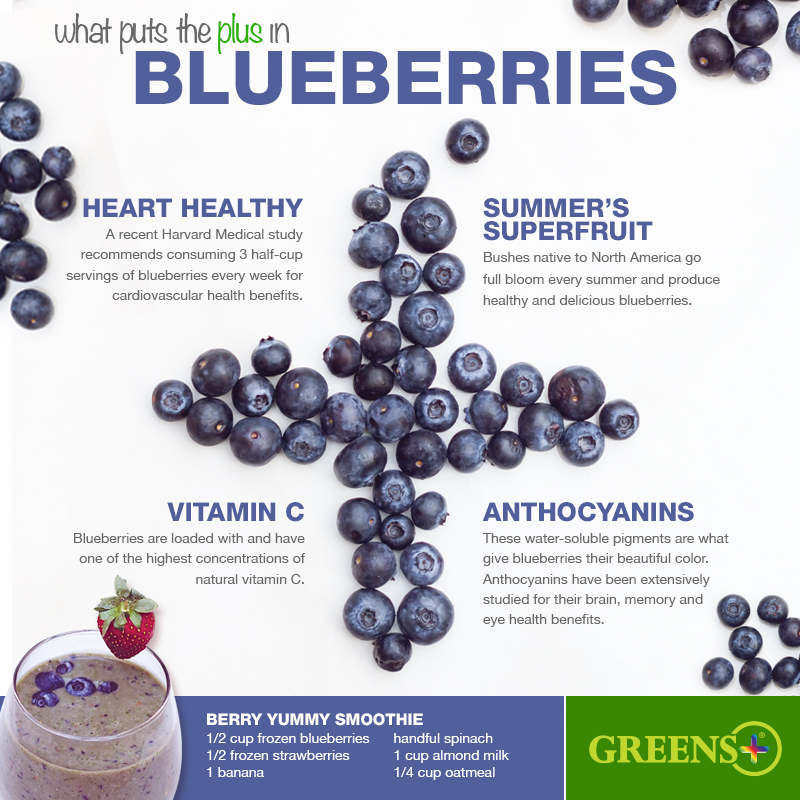
The version of this page that stood here made two claims that do not hold. It said blueberries have one of the highest concentrations of natural vitamin C, which is not close to true, and it attributed a serving recommendation to a Harvard study, which is not something studies do. Both are retracted below.
What is in a blueberry, and what is not
The compound that matters is anthocyanin. One cup of blueberries is one cup-equivalent of fruit under MyPlate, or half a day’s fruit for most adults. In the largest blueberry trial to date, a one-cup serving (150 g fresh, supplied as 26 g of freeze-dried powder) contained 364 mg of anthocyanins. That is a substantial dose by dietary standards. The Linus Pauling Institute puts total flavonoid intake among US adults at roughly 200 to 250 mg a day, of which anthocyanidins account for about 5%.
Content varies more than the marketing suggests. Kalt and colleagues’ 2020 review in Advances in Nutrition reported that across 215 blueberry phenotypes, the range between the 10th and 90th percentile spanned 0.925 to 2.1 mg of cyanidin-3-glucoside equivalents per gram of fresh fruit, a more than two-fold spread between ordinary berries on ordinary shelves.
Vitamin C is where the old page went wrong. Blueberries are a minor source. NIH’s Office of Dietary Supplements lists the notable food sources of vitamin C, and blueberries do not appear on it: half a cup of raw sweet red pepper carries 95 mg, a medium orange 70 mg, and half a cup of sliced strawberries 49 mg. They are likewise absent from the USDA vitamin C content listing that fact sheet draws on. On anthocyanins they are excellent; on vitamin C they are unremarkable. That distinction is covered further in the piece on vitamin C.
Anthocyanins, and how little of them gets in
This is the part the category tends to skip. Anthocyanins are very poorly absorbed. The Linus Pauling Institute notes that peak plasma concentrations after anthocyanin consumption are generally lower than 1 µM, which is orders of magnitude below the concentrations used in most cell-culture experiments that generate the enthusiasm.
What happens instead is that most of the dose reaches the colon, where bacteria strip the sugar and degrade the remaining structure. The resulting phenolic acids are absorbed and are what circulates in quantity. In carbon-13 tracer work summarized by Kalt’s review, substantial labeled carbon dioxide appeared in breath within six hours, indicating rapid and largely complete catabolism, while more than half the labeled carbon still remained in the body after 48 hours.
The consequence is that whatever effect blueberries have in people is probably not the work of intact anthocyanins. Kalt’s authors state the position directly: the bioactivity of anthocyanin metabolites in vivo, both collectively and individually, is still mostly unknown.
What the vascular trials found
The strongest single study is Curtis and colleagues’ 2019 trial in the American Journal of Clinical Nutrition: a six-month, double-blind, placebo-controlled randomized trial in 115 adults with metabolic syndrome, mean age 62.8, mean BMI 31.2. Three arms received 26 g of freeze-dried blueberry powder daily (one cup fresh, 364 mg anthocyanins), 13 g (half a cup, 182 mg), or a matched placebo.
The primary endpoint was insulin resistance measured by HOMA-IR, and it did not change. That is the first thing to know about the trial, and it is usually the last thing reported.
Among secondary endpoints, the one-cup arm showed flow-mediated dilation higher by 1.45 percentage points against placebo (P = 0.003) and augmentation index lower by 2.24% (P = 0.04). HDL cholesterol and apolipoprotein A-I rose among statin non-users. Blood pressure did not change. The half-cup dose produced no benefit on any of these measures, which makes the effective quantity a full cup every day for six months.
What the cognition trials found
Smaller and thinner. Miller and colleagues, publishing in the European Journal of Nutrition in 2018, ran a randomized, double-blind, placebo-controlled trial in 37 adults aged 60 to 75, who took 24 g of freeze-dried blueberry powder a day (about one cup of fresh fruit) for 90 days.
The battery was large: California Verbal Learning Test, task switching, trail making, digit span, a virtual Morris water maze and an attention network task. Two measures reached significance. Participants made fewer repetition errors on the verbal learning test (P = 0.031) and showed a reduced switch cost on the task-switching test (P = 0.033). Gait and balance did not improve.
Kalt’s review summarizes the wider set in similar terms: a 12-week juice study in older adults, improved list learning in school-aged children two hours after a dose, better executive performance in children aged 7 to 10 given 30 g of powder. Effects were generally larger in impaired populations than in healthy ones.
Why this literature is weaker than it looks
Four problems run through it, and they compound.
Sample sizes are small. A 115-person trial is respectable; a 37-person trial is not a basis for confident claims, and 37 is the larger end of the cognition literature rather than the smaller.
Multiplicity is unaddressed. Running six cognitive instruments and reporting the two that cleared P = 0.05 is close to what chance alone produces. Neither trial above was designed with cognition as a pre-registered primary endpoint tested once.
Funding is concentrated. Kalt’s review disclosed that the United States Highbush Blueberry Council paid each author an honorarium, and that several authors had received research funding from the same body. Miller’s trial listed the Highbush Blueberry Council among its funders alongside USDA. That does not make the results wrong. It does mean the questions were chosen by people with an interest in particular answers, and null results in that setting are less likely to reach publication.
And the authors’ own gaps are large. Kalt’s review states that the dose dependency of clinical effects is mostly unclear, that metabolite bioactivity is mostly unknown, and that mechanistic models usually apply a stress treatment rather than studying healthy tissue, which can inflate apparent benefit.
Two specific retractions belong here. The old version of this page said blueberries have one of the highest concentrations of natural vitamin C; they do not, and the ODS source list above is the correction. It also said “a recent Harvard Medical study recommends consuming 3 half-cup servings of blueberries every week.” We could not identify such a study, and individual observational studies do not issue serving recommendations in any case; they report associations, and clinical guidance is set by bodies reviewing whole literatures. The line is retracted.
The word “superfruit” is doing the same work ORAC scores used to do. USDA withdrew its own ORAC database in 2012 on the grounds that the values had no demonstrated relevance to human health, and no antioxidant ranking has replaced it with anything better.
Wild versus cultivated, fresh versus frozen
Wild lowbush blueberries generally test higher in anthocyanins than cultivated highbush. Kalt’s review put highbush at 387 mg per 100 g fresh weight and lowbush at 487 mg. That is a real difference of roughly a quarter, though it is smaller than the spread between individual cultivars within either type.
Freezing is not a compromise. The same review reported that anthocyanin loss during storage at −18°C was 12% after ten months, and that pasteurization caused minor losses under 10%. Wild blueberries are sold frozen far more often than fresh, which makes frozen wild berries a reasonable way to get a higher anthocyanin content at a lower price.
Freeze-dried powder degrades with heat rather than time as such: the review gave anthocyanin half-lives of 139 days at 25°C, 39 days at 42°C and 12 days at 60°C. Cool, dark storage matters more than the date on the bag. Fresh berries are covered in the piece on storing fruit and vegetables.
Common questions
How many blueberries would match the trials?
One cup of fresh blueberries a day, or the freeze-dried equivalent, taken for months rather than weeks. The 2019 trial found effects at 26 g of powder and none at 13 g, so half a cup appears not to be enough to reproduce what was measured.
Are frozen blueberries as good as fresh?
For anthocyanin content, close. The 2020 review reported a 12% loss after ten months at −18°C. Frozen berries are also cheaper, keep, and are the usual form for wild lowbush fruit.
Are wild blueberries worth paying more for?
They test higher in anthocyanins (487 against 387 mg per 100 g in the 2020 review), so on that measure yes, at a modest margin. Whether the difference produces any measurable outcome in a person has not been tested.
Do blueberry extracts do the same thing as the fruit?
Unknown. The trials above used whole freeze-dried fruit standardized for anthocyanin content, not isolated extracts, and the review notes that dose dependency for clinical effects is mostly unclear. An extract matching a trial’s anthocyanin dose is not the same as matching the trial.
Where this leaves it
Blueberries are a good fruit with an unusually high anthocyanin content, a small and mostly industry-funded human literature, and a set of measured effects that are modest and inconsistently replicated. That is a reasonable thing to eat. It is not a reason to build a diet around one berry.
The larger return is in total intake rather than in any single item, which is the argument in how many fruits and vegetables a day.
Greens Plus makes powders and bars that include fruit ingredients. A serving of any blended product delivers far less anthocyanin than the clinical doses discussed on this page, and no blend should be treated as a substitute for a cup of berries. Ingredient amounts are listed on each label and at greensplus.com.
About the Author