Vigorous exercise suppresses appetite for roughly an hour afterwards. That effect is real, it is measurable in blood, and it is far smaller than the marketing around it suggests. Over weeks and months, most people eat back a meaningful share of what they burn.
That combination (a genuine short-term effect and a disappointing long-term one) explains why exercise is a weak tool for losing weight and a strong one for keeping it off. The two claims are not in conflict, and this article works through why.
What happens to hunger right after hard exercise
The phenomenon is usually called exercise-induced anorexia. In a 2007 crossover study in the Journal of Applied Physiology, nine young men completed two nine-hour trials. In one, they ran for 60 minutes at 72% of maximal oxygen uptake. Acylated ghrelin (the form of the hunger hormone that stimulates intake) was lower across the first three hours of the exercise trial (317 versus 510 pg/ml over three hours), and rated hunger was lower over the same window.
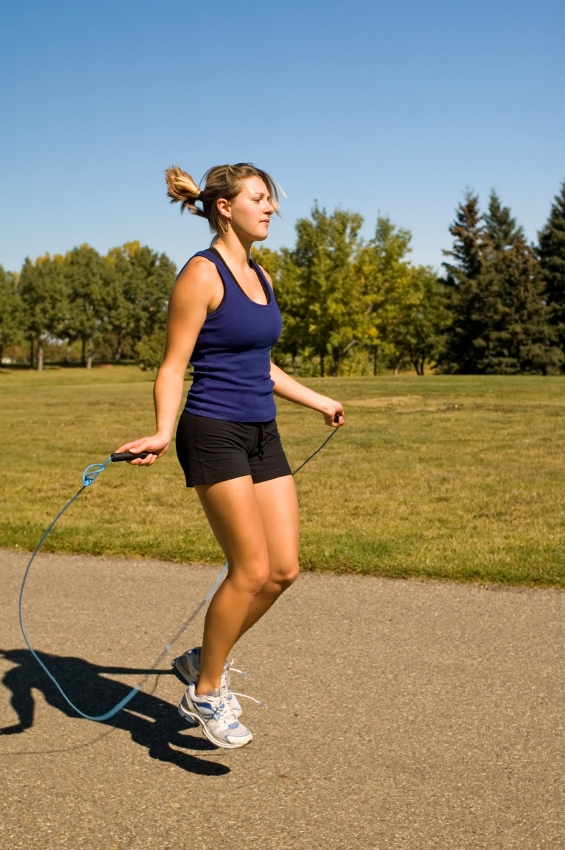
Now the retraction. The version of this article published here previously described a Japanese study as showing that “vertical” movements such as jumping rope beat cycling at suppressing ghrelin, via a mechanism it called gut disturbance. That study exists (Kawano and colleagues, Appetite, 2013, 15 young men across three trials), but its results do not say that.
The authors reported that rope skipping suppressed subjective hunger more than cycling. They also reported, in the same abstract, that acylated ghrelin and total peptide YY changed similarly in both conditions, with no significant difference between exercise modes. The hormone claim in the old article was not in the paper. Fifteen men in a single laboratory is also not a basis for choosing an exercise mode.
The hormones, and what the meta-analysis found
Ghrelin is not the only signal involved. Peptide YY, pancreatic polypeptide and glucagon-like peptide-1 all suppress intake, and exercise moves them too.
A 2014 systematic review and meta-analysis in Sports Medicine pooled acute exercise studies that reported full concentration-time curves for these hormones. It found that acute exercise lowered acylated ghrelin and raised PYY, PP and GLP-1 (a hormonal profile consistent with reduced appetite), with intensity mattering more than duration or mode.
A 2018 review in Nutrients added an important qualification: the responses vary considerably between individuals, and adiposity and sex did not reliably modify them. People who were already habitually active appeared better at adjusting intake to energy balance than sedentary people were.
Does appetite suppression mean eating less?
Only in a narrow sense, and the distinction matters.
A 2013 meta-analysis in Appetite pooled 29 studies covering 51 trials of a single exercise bout followed by an ad libitum meal. Exercise had a trivial effect on absolute energy intake (effect size 0.14, 95% CI −0.005 to 0.29) and a large effect on relative energy intake (effect size −1.35, 95% CI −1.64 to −1.05).
In plain terms: people did not eat noticeably more after exercising, so the calories they burned showed up as a net deficit that day. What they did not do was eat noticeably less. The suppression blunts a compensatory increase; it does not create a second deficit on top of the first.
Compensation, and why exercise is a weak weight-loss tool
Over weeks, the picture changes, because compensation is behavioral as well as hormonal, and it happens outside the laboratory.
A 2008 study in the International Journal of Obesity supervised 35 overweight adults through 12 weeks of exercise five times a week. Mean weight loss was 3.7 kg, close to what the energy expenditure predicted. But individual results ranged from −14.7 kg to +1.7 kg. The authors split participants into compensators, who lost 1.5 kg on average, and non-compensators, who lost 6.3 kg. The compensators showed higher reported energy intake and higher daily hunger.
Metabolic compensation adds to it. A 2021 analysis of 1,754 adults in Current Biology found that a typical person compensates about 28% of activity energy expenditure through reductions in basal expenditure, so roughly 72 cents on the dollar of extra activity shows up as extra total expenditure. Compensation was greater in people with more body fat.
The trial evidence lands where you would expect. A 2011 meta-analysis in the American Journal of Medicine pooled 14 randomized trials with 1,847 participants and found that aerobic exercise programs on their own produced weight changes of about −1.6 kg at six months and −1.7 kg at twelve months. The authors’ conclusion was blunt: isolated aerobic exercise is not an effective weight-loss therapy.
Where exercise is strong
None of the above is an argument against exercise. It is an argument against one specific use of it.
For keeping weight off, the association is consistent and large. The National Weight Control Registry analysis published in the American Journal of Clinical Nutrition in 2005 described members who had lost an average of 33 kg and kept it off more than five years; they reported roughly an hour a day of physical activity, alongside self-weighing and a consistent eating pattern.
A randomized trial adds support. In a 2008 study in the Archives of Internal Medicine, 201 overweight women were assigned to different activity targets alongside calorie restriction. Weight loss did not differ between the randomized groups, but participants who sustained a loss of 10% or more at 24 months reported doing substantially more physical activity than those who did not.
And the health case never depended on weight at all. The Physical Activity Guidelines for Americans, 2nd edition ask adults for 150 to 300 minutes a week of moderate-intensity aerobic activity, or 75 to 150 minutes of vigorous activity, plus muscle-strengthening on two or more days, a target set on health grounds, not on the scale.
What this evidence cannot tell you
Most acute appetite studies use small samples of young, lean, mostly male participants in laboratories, over single sessions of a few hours. Kawano’s 15 men and Broom’s nine are typical of the field, not unusual.
Appetite itself is measured with visual analogue scales (a mark on a line) and self-reported food intake is unreliable in a well-known direction. The hormone panel is a proxy for a system with many more inputs than the four hormones usually assayed.
Individual variation is the largest unexplained factor. The 12-week study above found people who lost 14 kg and people who gained, on the same prescribed program. Nothing in the current literature predicts reliably which you will be.
Using this in practice
A few things follow reasonably from the evidence.
- Do not treat a workout as an earned meal. A 45-minute session in most adults costs a few hundred calories, and a compensating snack recovers most of it.
- Expect the suppression to be short. If it makes a post-training meal easier to keep modest, that is the benefit; it will not carry through the evening.
- If fat loss is the goal, drive it primarily through intake and use training to protect lean mass and health. The reasoning is in our article on what actually drives fat loss and muscle gain.
- If maintenance is the goal, volume matters more than intensity, and consistency more than either. Our piece on the activity dose the guidelines ask for covers the targets.
- Intensity produces the sharpest acute appetite response, which is one of several arguments for short high-intensity sessions when time is the constraint.
The arithmetic underneath all of this is covered in our article on calories and energy balance.
Common questions
Why does an easy hour leave me hungrier than a hard 20 minutes?
The 2014 Sports Medicine meta-analysis found exercise intensity to be a stronger modifier of the appetite-hormone response than duration or mode. A longer easy session also burns more total energy, which gives compensation more to work with. Both point the same way, though neither has been tested head to head at length.
Does exercising before breakfast help?
Fasted training shifts which fuel is used during the session, but trials comparing fasted and fed training have not shown a consistent advantage for fat loss over days and weeks. If it suits your schedule and does not wreck the session, it is a reasonable choice; it is not a lever.
Is high-intensity exercise better for suppressing appetite?
The 2014 Sports Medicine meta-analysis found intensity to be the strongest modifier of the acute hormone response. The effect is still short-lived, and higher intensity carries more risk for people who are not conditioned to it.
Should I stop exercising for weight loss then?
No. The point is which job you assign it. Exercise performs poorly as the primary driver of weight loss and well as a driver of maintenance, fitness and preserved muscle. Assigning it the wrong job is what produces the disappointment.
The short version
Hard exercise lowers acylated ghrelin and raises PYY for an hour or two, and people do not usually eat more afterwards. Over months, behavioral and metabolic compensation absorbs much of the deficit, which is why exercise-only trials produce weight changes of a kilogram or two. As a maintenance and health tool it is one of the most reliable things available.
Nothing you drink changes any of that. If a greens blend helps you get more plant food into a training week, that is what Greens Plus is for, and it is not an appetite product.
About the Author