Nobody eats badly because they lack a list of healthy foods. The gap between knowing and doing is where almost all of the failure happens, and it is a problem about environments, defaults and specificity rather than information.
So this is not a list of foods to admire. It is what the behavior research says about changing what you eat, what the effect sizes actually are, and the specific substitutions that survive a normal week with a job and a commute in it.
Retiring the word “superfood”
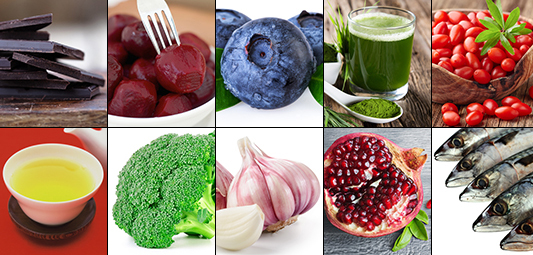
Start by dropping the term. “Superfood” has no regulatory definition and no nutritional one. The FDA regulates three kinds of statement on food and supplement labels — health claims, nutrient content claims and structure/function claims — and “superfood” is none of them. It appears nowhere in the Dietary Guidelines for Americans, in any edition.
It is a category invented to sell things, and it is used almost interchangeably with “expensive” and “imported.” We sell products the category is named after, and we still think the word costs you money without buying you anything.
The replacement is duller and more useful: eat a wider range of plants, more often. Kale is not superior to cabbage in any way that matters at the doses people eat. What matters is total plant volume, variety across the week, and the fiber that comes with it — a nutrient where about 5% of the US population reaches the recommended intake, against a Daily Value of 28 grams.
What actually decides what you eat
Food choice is far more responsive to what is in reach than to what you believe. That claim has been tested directly.
A 2019 Cochrane review examined whether altering the availability or proximity of products changes selection and consumption. Across 24 randomized studies, mostly laboratory-based, three comparisons of changed food availability (154 participants) found a large reduction in selection of the targeted food: a standardized mean difference of -1.13 (95% CI -1.90 to -0.37). A single study of drink proximity (41 participants) found placing a drink farther away reduced selection, SMD -0.65.
The reviewers graded that evidence low and very low certainty, which is the honest headline. The direction is consistent with everything anyone has observed about their own kitchen; the magnitude is not settled.
What follows from it practically is unglamorous. Wash and cut vegetables when you unpack the shopping, not when you are hungry. Keep fruit where you sit rather than in a drawer. Put the crisps on a high shelf. These are not moral acts; they are changes to how many seconds separate you from the food.
Be specific about when and where, not just what
The single best-supported technique in this literature is the implementation intention: an if-then plan naming a situation and a response. “When I make coffee after lunch, I will eat the apple on the counter” outperforms “I will eat more fruit,” and the difference is measurable.
A 2011 systematic review and meta-analysis in Appetite pooled 23 studies of implementation intentions and eating behavior. For adding healthy items to a diet, the pooled effect was Cohen’s d = 0.51. For reducing unhealthy eating, it was weaker, d = 0.29.
That asymmetry is worth planning around. Addition works better than subtraction, at least in the studies that exist. Adding beans to a meal is a better-evidenced move than resolving to eat fewer chips.
How long this takes, and why that number gets misquoted
The “21 days to a habit” figure has no research behind it. The study people are actually reaching for is a 2010 paper in the European Journal of Social Psychology, in which 96 volunteers chose one eating, drinking or activity behavior to perform daily in a fixed context for 12 weeks, rating automaticity as they went.
Time to reach 95% of maximum automaticity ranged from 18 to 254 days, averaging about 66. The range is the finding, not the average. It also means missing a day is not a reset; the curves absorbed occasional lapses without much penalty.
Where this evidence is thin
None of the above is strong in the way a large drug trial is strong, and it would be dishonest to present it that way.
The Cochrane availability review rested on 24 studies, most of them run in laboratories with small samples, and the reviewers rated certainty low to very low. Laboratory food choice is not a supermarket at six o’clock with children in the cart.
The implementation-intention meta-analysis carried its own caveat: the authors noted that for studies aiming to increase healthy eating, higher-quality outcome measures and lower-quality control conditions tended to produce stronger effects, meaning some of that d = 0.51 is likely inflated. The habit study followed 96 people, mostly students, for 12 weeks on self-reported measures.
What survives all of that is a modest, consistent direction: specificity helps, proximity helps, and adding is easier than removing. Those are worth acting on. They are not a guarantee.
Substitutions that survive a normal week
Each of these is a swap inside an existing habit, which is why they hold. None requires a new shopping route or a new skill.
- Frozen spinach or peas into whatever is already in the pan. No washing, no spoilage, no decision.
- Half the ground meat in a chili, bolognese or taco filling replaced with lentils. The texture change is small, the fiber change is not.
- Whole grain or seeded bread instead of white, chosen once at the shelf rather than at every meal.
- Canned beans rinsed into a salad, soup or a tin of tuna, adding several grams of fiber for about a minute of work.
- Plain yogurt with fruit instead of flavored yogurt, which moves the added sugar without touching the routine.
- Nuts or seeds instead of a snack from a vending machine, kept in a desk drawer so the proximity argument works in your favor.
Two structural moves matter more than any of them. Buy more frozen and canned produce, which is nutritionally serious, cheaper and does not rot; and keep the fresh produce you buy alive, which our guide to storing fruit and vegetables deals with in detail.
Additions, which work better than restrictions
Given that the evidence favors adding over removing, build the week around additions with a named trigger attached.
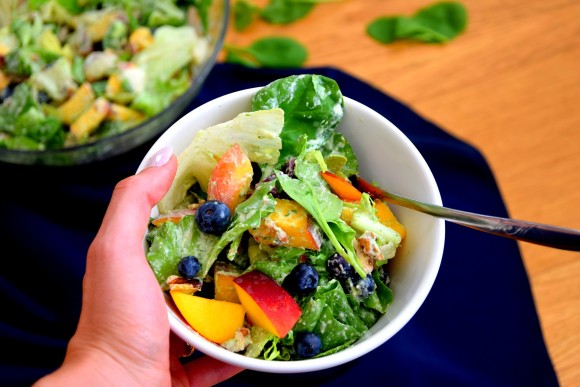
One legume meal a day is the highest-yield single change most people can make, because beans and lentils carry fiber, protein and a serious amount of potassium at once, at roughly 731 mg per half-cup serving of lentils. A piece of fruit attached to an existing daily event — the coffee, the commute, the school run — is the second, against a MyPlate target of one and a half to two cups a day. A vegetable side that requires no cooking, such as sliced cucumber, cherry tomatoes or shredded cabbage with vinaigrette, is the third.
If children are part of the calculation, the mechanics differ enough to need their own treatment, and we cover them in getting children to eat vegetables. For the underlying case on intake, see fruit and vegetable intake.
Common questions
Are expensive imported foods better than cheap local ones?
Not in any way the evidence supports. Acai, goji and their successors are perfectly good foods with no demonstrated advantage over blackberries, carrots or cabbage at real-world portions. The premium buys novelty, not nutrition.
Is frozen produce as good as fresh?
For most purposes, yes, and sometimes better, because it is picked and frozen close to ripeness while fresh produce loses nutrients in transit and storage. The bigger practical point is that frozen vegetables are still there in week two, and the fresh ones often are not.
What if I only manage one change?
Make it legumes at one meal a day, tied to a specific meal you already eat. It moves fiber, potassium and protein simultaneously, costs very little, and fits the pattern the research favors: an addition, with a named trigger, inside an existing routine.
Does a greens powder count as eating more plants?
Partly. It widens the range of plants in a diet that has few, which is a real benefit, but a 5 to 10 gram scoop cannot supply the volume or fiber that vegetables do. If you are considering one, our buyer’s guide to greens powders explains what to check on the label.
Where to start
Pick one addition, attach it to something you already do every day, and put it physically in your way. That is the entire evidence-based method, and it is duller and more reliable than any list of exotic ingredients.
For the days that go badly, a fully disclosed greens powder is a reasonable backstop rather than a strategy, and ours are at Greens Plus.
These statements have not been evaluated by the Food and Drug Administration. This product is not intended to diagnose, treat, cure or prevent any disease.
About the Author